
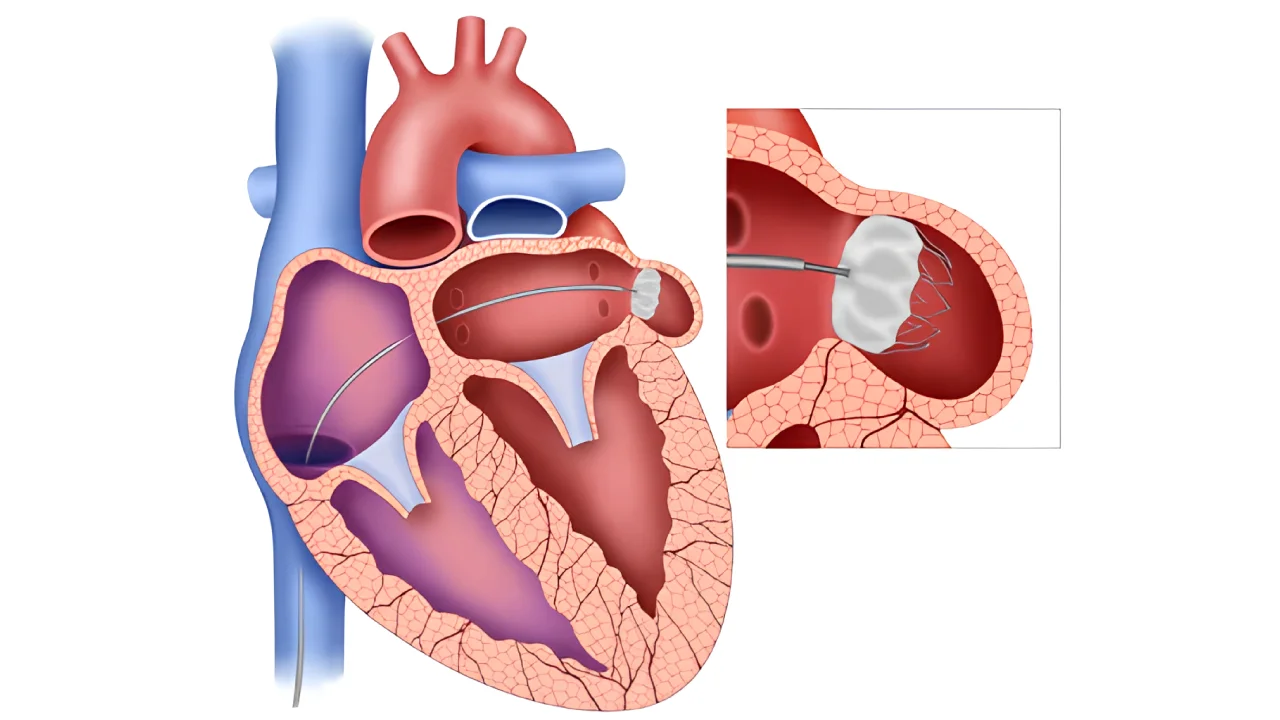
Left atrial appendage (LAA) closure is a minimally invasive procedure performed to reduce stroke risk in patients with atrial fibrillation. During the procedure, a small pouch inside the left upper chamber of the heart (where blood clots most commonly form) is sealed using a special closure device.
The procedure is usually performed through thin catheters inserted from a vein in the groin. The chest is not opened, and open-heart surgery is not required. LAA closure has become an important treatment option especially for patients who have difficulty using blood thinners or who have a high risk of bleeding.
- What is the left atrial appendage (LAA)?
- How is it related to atrial fibrillation?
- Who is a candidate for LAA closure?
- How is the procedure performed?
- How long does the procedure take?
- What is recovery like after LAA closure?
- Is LAA closure a permanent solution?
- Are there risks?
- Is it the same as atrial fibrillation ablation?
- Can patients return to normal daily life?
- When should medical attention be sought?
What is the left atrial appendage (LAA)?
The left atrial appendage is a small pouch-like structure attached to the left upper chamber of the heart. It is commonly referred to as the LAA.
In healthy individuals, it usually does not cause any problems. However, during atrial fibrillation, the upper chambers of the heart beat irregularly, which may cause blood to stagnate inside the LAA. Over time, this stagnant blood can form clots.
If a clot leaves the heart and travels to the brain, it can cause a stroke. Most clot-related strokes associated with atrial fibrillation originate from the left atrial appendage.
How is it related to atrial fibrillation?
Atrial fibrillation is a heart rhythm disorder in which the upper chambers of the heart beat rapidly and irregularly. During this abnormal rhythm, blood flow may slow down, particularly inside the LAA, increasing the risk of clot formation.
For this reason, many patients with atrial fibrillation are treated with blood thinners to reduce stroke risk. However, long-term anticoagulant therapy may not be suitable for everyone because of bleeding risk.
LAA closure aims to reduce stroke risk by sealing off the area where clots most commonly develop.
Who is a candidate for LAA closure?
LAA closure is not necessary for every patient with atrial fibrillation. Stroke risk and bleeding risk must first be evaluated together.
The procedure may be considered in patients who have had serious bleeding episodes, gastrointestinal bleeding, previous brain hemorrhage, or difficulties using blood thinners.
It may also be an option in selected patients who develop clots despite anticoagulant therapy.
The decision is usually made after a detailed evaluation by a cardiology team.
How is the procedure performed?
LAA closure is usually performed under general anesthesia. Thin catheters are inserted through a vein in the groin and guided into the heart.
The catheter is first advanced into the right side of the heart and then passed through the thin wall between the upper chambers to reach the left side. A specially designed closure device is then positioned at the opening of the LAA.
Throughout the procedure, transesophageal echocardiography and fluoroscopic imaging are used together to guide device placement and confirm correct positioning.
The goal is to safely seal the left atrial appendage and isolate the area where clots may form.
How long does the procedure take?
LAA closure usually takes between one and two hours, although the duration may vary depending on the patient’s anatomy and the type of device used.
Most patients stay in the hospital overnight for observation and are discharged the following day.
What is recovery like after LAA closure?
Recovery after LAA closure is generally quick. Mild bruising or tenderness around the groin area may occur, but most patients return to daily activities within a short time.
For a limited period after the procedure, blood thinners or antiplatelet medications may still be used while the device surface heals. Medication plans are individualized based on the patient’s condition.
Follow-up visits usually include echocardiographic evaluation to assess device position and confirm closure of the appendage.
Is LAA closure a permanent solution?
LAA closure can provide long-term protection against clot formation. Over time, the implanted device becomes covered by the body’s own tissue and integrates into the heart.
The long-term success of the treatment depends not only on device placement but also on the patient’s overall heart condition and regular follow-up.
Are there risks?
LAA closure is a widely performed and generally safe procedure when carried out in experienced centers. Mild bruising or minor bleeding at the groin site are among the most common issues.
As with any invasive cardiac procedure, there are certain risks that are carefully monitored. For this reason, the heart structure, LAA anatomy, and overall health condition of the patient are evaluated in detail before the procedure.
In older patients or those with multiple medical conditions, treatment planning is usually performed by a multidisciplinary heart team.
Is it the same as atrial fibrillation ablation?
No. Atrial fibrillation ablation and LAA closure are different procedures.
Ablation aims to control or reduce the abnormal heart rhythm, while LAA closure is intended to reduce stroke risk.
In some patients, both procedures may be performed during the same session or at different times.
Can patients return to normal daily life?
Most patients are able to return to normal daily activities after the procedure. Light walking can usually be resumed within a short time.
Exercise plans should be tailored according to the patient’s overall heart condition. Regular follow-up and continued medication use remain important.
When should medical attention be sought?
Increasing shortness of breath, chest pain, palpitations, or fainting after the procedure should be evaluated.
Patients should also seek medical attention if they notice significant swelling, active bleeding, or redness around the groin access site.
Sudden speech problems, weakness, or vision changes require urgent medical evaluation.
Frequently Asked Questions
Is LAA closure an operation?
No. It is a minimally invasive catheter-based procedure and does not require open-heart surgery.
Is the heart stopped during the procedure?
No. The heart continues beating throughout the procedure.
Is it performed in every patient with atrial fibrillation?
No. It is mainly considered in selected patients who have problems with long-term blood thinner use or high bleeding risk.
Can it be performed together with atrial fibrillation ablation?
Yes. In selected patients, LAA closure and atrial fibrillation ablation may be performed during the same procedure.
Can MRI be performed after the procedure?
Most modern LAA closure devices are MRI compatible, although patients should always inform healthcare providers before imaging.
Is the implanted device permanent?
Yes. The device remains permanently in place and becomes covered by the body’s own tissue over time.
Can blood thinners be stopped after LAA closure?
In some patients, strong anticoagulants may be reduced or discontinued. The medication plan is individualized.