
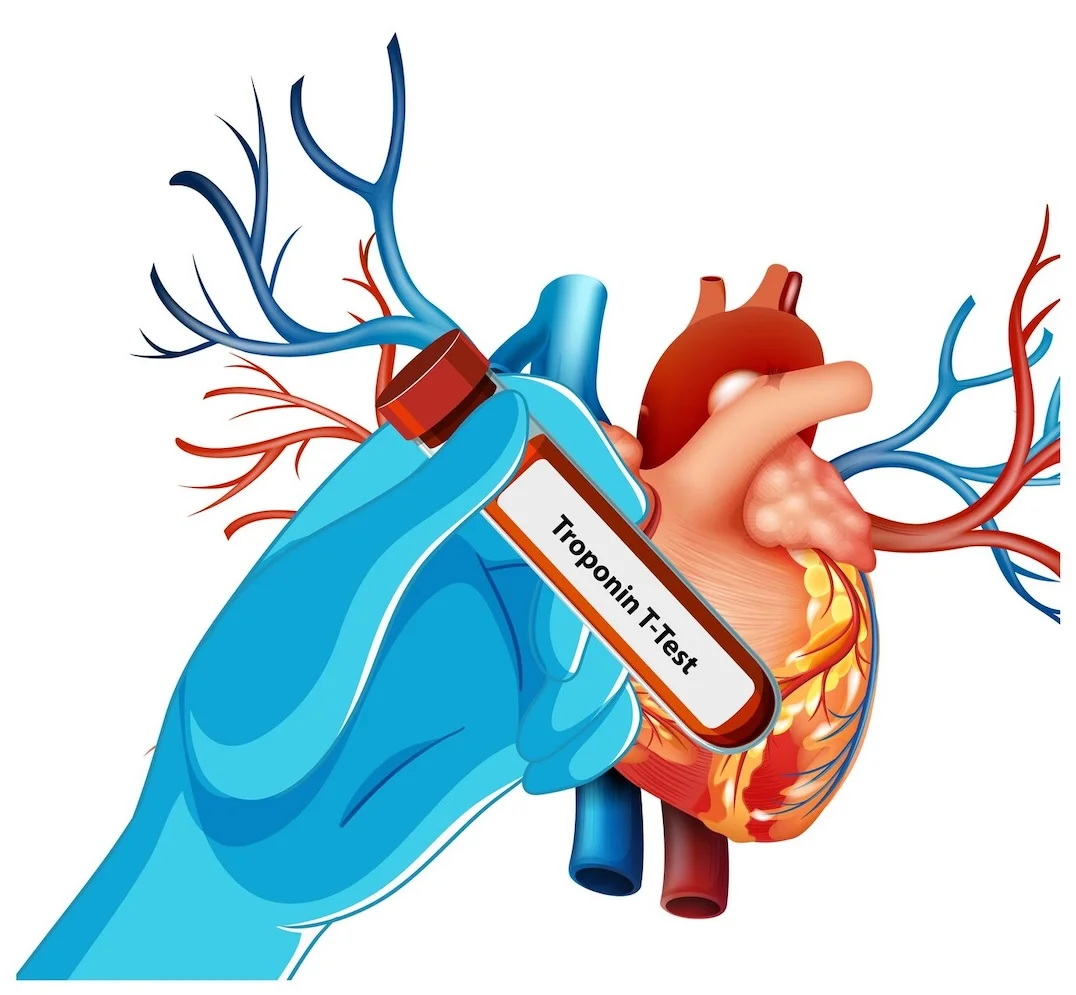
What is troponin?
Troponin is a group of proteins that regulate heart muscle contraction. There are three different types of troponin. These proteins work together to ensure that the heart beats regularly and effectively.
In blood tests, Troponin I and Troponin T are measured most often because they are specific to heart muscle. When their levels rise in the blood, it usually indicates heart muscle injury.
Troponin I (TnI)
Troponin I is a protein that controls heart muscle contraction. Under normal conditions, it is present in very small amounts in the blood. After a heart attack, troponin I begins to rise approximately 4–6 hours later and usually peaks within 12–24 hours. It can remain elevated for 5–10 days.
Because it is highly specific to heart muscle, troponin I is one of the most commonly measured markers in clinical practice.
Troponin T (TnT)
Troponin T binds the troponin complex to other structures within the heart muscle. Like troponin I, it is specific to the heart. Troponin T typically begins to rise 4–8 hours after heart injury and may remain elevated for 10–14 days.
This prolonged elevation is particularly helpful for diagnosing patients who present late after symptom onset.
Troponin C (TnC)
Troponin C binds calcium and triggers muscle contraction. Unlike the other forms, it is found in both heart muscle and skeletal muscle. For this reason, it is not specific to the heart and is not used in diagnostic blood tests.
What does troponin do?
Troponin is a regulatory protein complex that plays a vital role in normal heart muscle contraction. By controlling the interaction between calcium and muscle proteins, it allows the heart to contract in a coordinated and effective manner, ensuring proper blood flow throughout the body.
Because troponin proteins are highly specific to heart muscle, their presence in the blood almost always indicates heart muscle damage, making them extremely valuable in cardiac diagnosis.
Why are troponin tests clinically important?
Troponin I and T tests are essential for diagnosing heart attacks because:
- They are highly specific to heart muscle
- They are very sensitive and can detect even small amounts of heart damage
- They remain elevated for a long time after injury, allowing diagnosis even in delayed presentations
The development of high-sensitivity troponin tests has significantly improved early detection and risk assessment. These tests can identify minimal heart muscle injury that previously went undetected, enabling earlier treatment.
Troponin levels are also used to assess the severity of heart damage and prognosis. Higher troponin levels usually indicate more extensive heart injury and a worse prognosis.
Why is a troponin test ordered?
A troponin test is most commonly ordered when you come to the hospital with chest pain, when a heart attack is suspected, or when doctors want to determine whether there has been damage to the heart muscle.
In healthy individuals, blood troponin levels are very low, typically below 0.04 ng/mL. In conditions such as a heart attack, damaged heart cells release troponin into the bloodstream, causing levels to rise. Values above 0.4 ng/mL generally suggest heart muscle injury.
What does elevated troponin mean?
An elevated troponin level usually indicates heart muscle damage. The most common cause is a heart attack, but many other conditions can also raise troponin levels, including:
- Heart failure
- Myocarditis (inflammation of the heart muscle)
- Pericarditis (inflammation of the heart lining)
- Pulmonary embolism
- Sepsis
- Kidney failure
- Prolonged or intense exercise (especially endurance events such as marathons)
- Cardiac trauma or surgery
- Toxic effects of certain medications
For this reason, elevated troponin levels must always be interpreted together with symptoms, physical examination, ECG findings, and other test results.
What is the troponin level in a heart attack?
Normal troponin values are generally below 0.04 ng/mL, though reference ranges may vary by laboratory. During a heart attack, levels typically rise to two to three times the upper limit of normal, and sometimes much higher.
Troponin begins to rise within the first few hours after injury and usually reaches peak levels within 12–24 hours, depending on the extent of heart muscle damage.
How can troponin levels be lowered?
There is no medication that directly lowers troponin levels because elevated troponin is not a disease itself, but a marker of underlying heart damage. The key is to treat the condition causing the elevation.
In heart attacks, early treatment limits heart muscle damage. As the heart heals, troponin levels gradually return to normal. Treatment may include opening blocked arteries with stents or bypass surgery, blood-thinning medications, and heart-protective drugs.
In non–heart attack causes (such as myocarditis or heart failure), troponin levels decrease as the underlying condition is treated.
In summary, troponin elevation should be viewed as a signal, and treatment should focus on the cause rather than the troponin level itself.
How is the troponin test performed?
The troponin test is a simple blood test. A blood sample is taken from a vein in your arm and analyzed in the laboratory. No special preparation is required, and fasting is not necessary.
Results are usually available within 1–3 hours, and even faster testing may be used in emergency situations. Results are reported in nanograms per milliliter (ng/mL).
FAQs about troponin
What does a low troponin level mean?
Low or normal troponin levels are a good sign and usually indicate that there is no significant heart muscle damage.
Is the troponin test alone enough to diagnose a heart attack?
No. Although troponin is a crucial marker, diagnosis also depends on symptoms, physical examination, ECG findings, and other tests.
Which troponin type is more important: I, T, or C?
Troponin I and T are most important because they are specific to heart muscle. Troponin C is not heart-specific and is not used diagnostically.
Is there a difference between troponin I and troponin T?
Both are heart-specific and equally valuable diagnostically. Troponin I remains elevated for 5–10 days, while troponin T may stay elevated for 10–14 days. The choice depends on the laboratory.
Can exercise increase troponin levels?
Normal daily exercise does not significantly raise troponin levels. Very intense endurance exercise may cause mild, temporary increases that are not related to heart attacks.
How long does it take to get troponin test results?
Most standard tests provide results within 1–3 hours, while rapid bedside tests may give results even sooner.
Does elevated troponin always mean a heart attack?
No. Troponin can be elevated in many other conditions. The cause must always be evaluated by a physician.
Conclusion
The troponin test is a lifesaving diagnostic tool in patients with suspected heart attacks. By enabling rapid and accurate diagnosis, it allows early treatment and helps limit heart muscle damage. Anyone experiencing chest pain should seek immediate medical attention to benefit from timely testing and appropriate care.